


Marbled Godwit

General Description
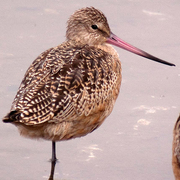
Marbled Godwits are large shorebirds with slightly upturned bills. They are mottled brown with cinnamon underwings that are distinctive in flight. In winter, they are plain underneath, but during the breeding season they have dark barring on their breasts and bellies.
Habitat
They nest in native prairie habitats: wet meadows and grassy areas near water. During migration and winter, they are coastal, foraging on mudflats, salt marshes, estuaries, and coastal pools.
Behavior
Marbled Godwits are commonly seen in flocks with Whimbrels and Long-billed Curlews, both large and brown like the Marbled Godwit. The Marbled Godwit moves slowly, probing for food under the mud with its sensitive bill. It often inserts its entire bill into the mud, and its head is totally submerged at times.
Diet
In summer, Marbled Godwits eat insects, roots, and seeds. During migration, they may forage almost exclusively on tubers. In coastal areas, they eat mollusks, crustaceans, and other aquatic creatures that live in the sand and mud.
Nesting
Marbled Godwits form loose colonies without obvious territorial boundaries. To attract a female, the male performs a high, circling flight display, followed by a steep dive. The male selects a nest site in a dry spot with short grass and starts a shallow scrape. If the female approves it, both will add grass, and sometimes a canopy of grass is arched over the nest. Both parents incubate the four eggs for 24 to 26 days. The young leave the nest soon after hatching and find their own food. Both parents protect and tend the young for the first 15 to 26 days, after which the female usually leaves. The male stays with the young until they can fly.
Migration Status
Most Marbled Godwits winter in coastal California or Mexico, and some range as far as South America. They migrate in flocks, with juveniles following a few weeks behind the adults. Birds migrate south through Washington in late August through mid-September, and return to the breeding grounds in April through early May.
Conservation Status
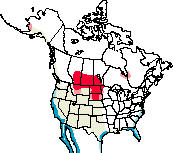
Marbled Godwits breed in Canada and the interior and north-central area of the United States. The Canadian Wildlife Service estimates the population at 171,500 birds. They were common in the 1800s, but were over-hunted in the early 1900s. Protection from hunting has helped the population rebound, but the destruction of grassland breeding habitat now limits the population.
When and Where to Find in Washington
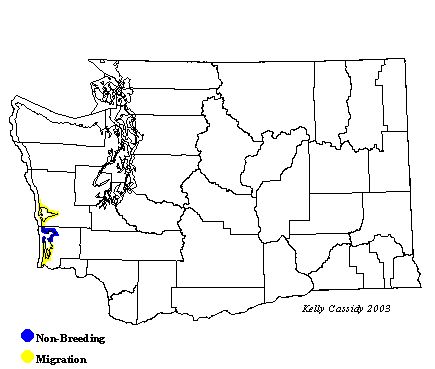
Marbled Godwits are most likely to be seen in protected estuaries along the outer coast, from Grays Harbor south, from April to early May, and from July into October. Birds seen later in the fall, from September to October, are usually juveniles. Large flocks often feed on the golf course in Ocean Shores (Grays Harbor County) in the spring. A flock also winters regularly at Tokeland in Willapa Bay (Pacific County). Other possible sites are Blaine (Whatcom County) and Sequim (Clallam County).
 Abundance
| Ecoregion | Jan | Feb | Mar | Apr | May | Jun | Jul | Aug | Sep | Oct | Nov | Dec |
|---|---|---|---|---|---|---|---|---|---|---|---|---|
| Oceanic | ||||||||||||
| Pacific Northwest Coast | C | C | C | C | U | R | U | C | C | C | C | C |
| Puget Trough | R | R | R | R | R | R | R | R | R | R | ||
| North Cascades | ||||||||||||
| West Cascades | ||||||||||||
| East Cascades | ||||||||||||
| Okanogan | ||||||||||||
| Canadian Rockies | ||||||||||||
| Blue Mountains | ||||||||||||
| Columbia Plateau | R | R |
Washington Range Map
North American Range Map
Family Members
 Spotted SandpiperActitis macularius
 Solitary SandpiperTringa solitaria
 Gray-tailed TattlerTringa brevipes
 Wandering TattlerTringa incana
 Greater YellowlegsTringa melanoleuca
 WilletTringa semipalmata
 Lesser YellowlegsTringa flavipes
 Upland SandpiperBartramia longicauda
 Little CurlewNumenius minutus
 WhimbrelNumenius phaeopus
 Bristle-thighed CurlewNumenius tahitiensis
 Long-billed CurlewNumenius americanus
 Hudsonian GodwitLimosa haemastica
 Bar-tailed GodwitLimosa lapponica
 Marbled GodwitLimosa fedoa
 Ruddy TurnstoneArenaria interpres
 Black TurnstoneArenaria melanocephala
 SurfbirdAphriza virgata
 Great KnotCalidris tenuirostris
 Red KnotCalidris canutus
 SanderlingCalidris alba
 Semipalmated SandpiperCalidris pusilla
 Western SandpiperCalidris mauri
 Red-necked StintCalidris ruficollis
 Little StintCalidris minuta
 Temminck's StintCalidris temminckii
 Least SandpiperCalidris minutilla
 White-rumped SandpiperCalidris fuscicollis
 Baird's SandpiperCalidris bairdii
 Pectoral SandpiperCalidris melanotos
 Sharp-tailed SandpiperCalidris acuminata
 Rock SandpiperCalidris ptilocnemis
 DunlinCalidris alpina
 Curlew SandpiperCalidris ferruginea
 Stilt SandpiperCalidris himantopus
 Buff-breasted SandpiperTryngites subruficollis
 RuffPhilomachus pugnax
 Short-billed DowitcherLimnodromus griseus
 Long-billed DowitcherLimnodromus scolopaceus
 Jack SnipeLymnocryptes minimus
 Wilson's SnipeGallinago delicata
 Wilson's PhalaropePhalaropus tricolor
 Red-necked PhalaropePhalaropus lobatus
 Red PhalaropePhalaropus fulicarius