
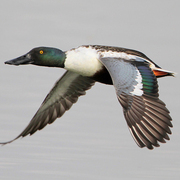


Northern Shoveler
General Description
The very large, spatulate bill is the most distinguishing feature of the aptly named Northern Shoveler. The male in breeding plumage has bright wings, a bright iridescent-green head with a yellow eye, bold white breast, and chestnut sides. Females, juveniles, and males in eclipse plumage (from May through August) are mottled brown with orange legs and a green-black iridescent speculum with a blue patch on the forewing.
Habitat
Northern Shovelers inhabit shallow, marshy ponds and wetlands at low elevations. Breeding habitat is in open country (prairie or tundra), or lowland woodlands and clearings, always near shallow water. During winter and migration they will use virtually any wetland as long as it has muddy edges. Shovelers will forage in sewage ponds and stagnant or polluted waters avoided by other species of ducks.
Behavior
Northern Shovelers rarely tip up, but filter mud through their bills, swimming with their heads outstretched, bills skimming the water's surface, sifting out food. In flight they stay in tight bunches, weaving to and fro like shorebirds. Shovelers are the most territorial of all the North American dabblers, and pair bonds remain intact through incubation, unlike most other species of ducks.
Diet
The bill of the Shoveler is ideally suited for straining small swimming invertebrates from the water and mud. Seeds and aquatic plants are also important food items, especially during winter.
Nesting
Pair formation begins in the winter and continues during spring migration. Males remain with the females through the incubation period. The female chooses the site (generally in short grass). She builds the nest, a shallow depression made of grass and weeds, lined with down, and incubates the 9 to 12 eggs for 23 to 28 days by herself. A few hours after they hatch, the female leads the young to the water where they can swim and forage immediately. The young typically stay close to the cover of emergent vegetation, and the female tends them until they fledge at 52 to 66 days of age.
Migration Status
Northern Shovelers migrate in flocks in a prolonged migration period in both the spring and the fall. The spring migration is relatively late, usually peaking about the end of April. The fall migration begins in August, peaks in September, and continues into November. Many Northern Shovelers winter in Washington.
Conservation Status
Due to their highly specialized bills and consequent habitat requirements, the Northern Shoveler appears to be less affected by drought and food scarcity than other dabblers. This may explain how this species has maintained long-term stable populations.
When and Where to Find in Washington
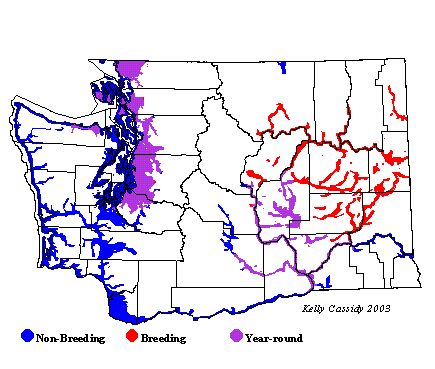
The Northern Shoveler is a common breeder throughout Washington's lowland ponds and wetlands (although some birds sighted in summer on the west side of the Cascades are non-breeders). It is also a common winter resident. Northern Shovelers are more common breeders on the east side of the Cascades than on the west side, but more common wintering on the west side in appropriate habitat.
 Abundance
| Ecoregion | Jan | Feb | Mar | Apr | May | Jun | Jul | Aug | Sep | Oct | Nov | Dec |
|---|---|---|---|---|---|---|---|---|---|---|---|---|
| Oceanic | ||||||||||||
| Pacific Northwest Coast | F | F | F | C | U | R | R | U | U | F | F | F |
| Puget Trough | C | C | C | C | C | F | F | F | C | C | C | C |
| North Cascades | R | R | R | R | R | R | R | R | R | |||
| West Cascades | C | C | C | C | U | U | U | U | F | C | C | C |
| East Cascades | R | R | U | U | U | U | U | U | R | R | ||
| Okanogan | U | C | C | C | C | C | C | C | C | C | ||
| Canadian Rockies | F | F | F | F | F | F | F | |||||
| Blue Mountains | U | U | R | U | R | |||||||
| Columbia Plateau | C | C | C | C | C | F | F | F | C | C | C | C |
Washington Range Map
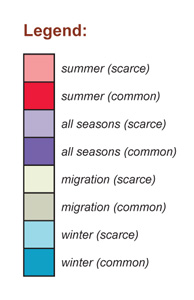
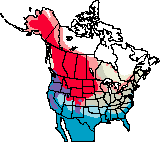
North American Range Map
Family Members
 Fulvous Whistling-DuckDendrocygna bicolor
 Taiga Bean-GooseAnser fabalis
 Greater White-fronted GooseAnser albifrons
 Emperor GooseChen canagica
 Snow GooseChen caerulescens
 Ross's GooseChen rossii
 BrantBranta bernicla
 Cackling GooseBranta hutchinsii
 Canada GooseBranta canadensis
 Mute SwanCygnus olor
 Trumpeter SwanCygnus buccinator
 Tundra SwanCygnus columbianus
 Wood DuckAix sponsa
 GadwallAnas strepera
 Falcated DuckAnas falcata
 Eurasian WigeonAnas penelope
 American WigeonAnas americana
 American Black DuckAnas rubripes
 MallardAnas platyrhynchos
 Blue-winged TealAnas discors
 Cinnamon TealAnas cyanoptera
 Northern ShovelerAnas clypeata
 Northern PintailAnas acuta
 GarganeyAnas querquedula
 Baikal TealAnas formosa
 Green-winged TealAnas crecca
 CanvasbackAythya valisineria
 RedheadAythya americana
 Ring-necked DuckAythya collaris
 Tufted DuckAythya fuligula
 Greater ScaupAythya marila
 Lesser ScaupAythya affinis
 Steller's EiderPolysticta stelleri
 King EiderSomateria spectabilis
 Common EiderSomateria mollissima
 Harlequin DuckHistrionicus histrionicus
 Surf ScoterMelanitta perspicillata
 White-winged ScoterMelanitta fusca
 Black ScoterMelanitta nigra
 Long-tailed DuckClangula hyemalis
 BuffleheadBucephala albeola
 Common GoldeneyeBucephala clangula
 Barrow's GoldeneyeBucephala islandica
 SmewMergellus albellus
 Hooded MerganserLophodytes cucullatus
 Common MerganserMergus merganser
 Red-breasted MerganserMergus serrator
 Ruddy DuckOxyura jamaicensis