
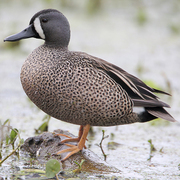


Blue-winged Teal
General Description
Blue-winged Teal are small dabblers with long bodies and bills. Males in breeding plumage have russet-colored bodies with small, dark spots, black undertail coverts, and white patches on their flanks. Their heads are dark blue-gray with a distinctive white crescent in front of each eye. Males are in non-breeding or eclipse plumage from July to October, during which time they look like females and can easily be confused with Cinnamon Teal in the same plumage. Juveniles and females are mottled brown with a dark bill and yellowish legs. Both males and females have green-black speculums, with pale blue patches on the forewing.
Habitat
Blue-winged Teal inhabit shallow wetlands with emergent vegetation. Their breeding habitat is usually open-country wetlands. During migration they are sometimes found over the ocean, many miles from shore.
Behavior
Fast and agile flyers, Blue-winged Teal are often seen in small flocks, twisting and turning as a single unit. When foraging they usually stick to very shallow water, plucking food items from the surface and swimming with their heads partially submerged. They do not tend to up-end or feed out of the water.
Diet
Like other dabblers, Blue-winged Teal eat grass and aquatic plant seeds, as well as insects and other aquatic invertebrates. These invertebrates make up a larger proportion of their diet than that of other dabblers.
Nesting
Pair formation begins in the winter and continues through spring migration. Blue-winged Teal nest on the ground in prairies, coastal meadows, and other open areas. Nests are usually near water, but may be several hundred yards away. The nest is a shallow depression with some grass or weeds, lined with down and usually well concealed by vegetation. The female incubates 9 to 13 eggs alone for 23 to 24 days. The young leave the nest within a day of hatching and can swim and find their own food immediately. The female continues to protect and tend them for a few weeks, but she leaves them before they are old enough to fly, which happens around 38 to 49 days.
Migration Status
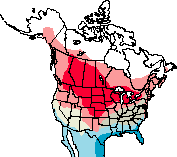
Blue-winged Teal are highly migratory and are, for the most part, absent from the majority of North America during the cold months of the year. They winter more extensively in South America than any other dabbler. They begin migrating later in spring than other dabblers, with birds arriving on the coast as early as March, but mostly not before April and May. Single males arrive first, with pairs and unpaired females following. Males migrate again from mid-July to mid-August, moving to larger marshes to undergo their molt. Fall migration starts in early August, and most birds are gone by mid-October.
Conservation Status
Numbers of Blue-winged Teal nesting in Washington have increased dramatically in the last century. Blue-winged Teal now outnumber Cinnamon Teal in some parts of eastern Washington. This shift is most likely due to large damming projects that have converted small wetlands into large reservoirs more favorable to the Blue-winged than the Cinnamon Teal.
When and Where to Find in Washington
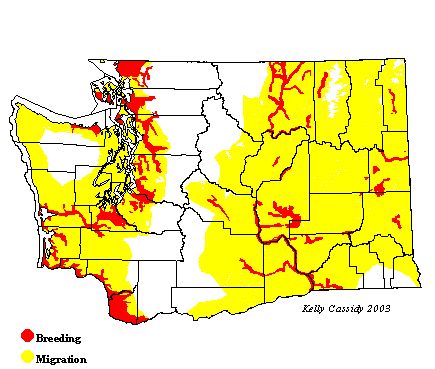
Blue-winged Teal are extremely rare in Washington during winter. They typically arrive in mid-April and depart by the end of September. West of the Cascades they are uncommon breeders, and their range is somewhat limited to freshwater wetlands in the Puget Trough and coastal areas. In eastern Washington, they are common in wetlands throughout the region.
 Abundance
| Ecoregion | Jan | Feb | Mar | Apr | May | Jun | Jul | Aug | Sep | Oct | Nov | Dec |
|---|---|---|---|---|---|---|---|---|---|---|---|---|
| Oceanic | ||||||||||||
| Pacific Northwest Coast | R | U | U | U | U | U | R | |||||
| Puget Trough | R | F | F | U | U | R | ||||||
| North Cascades | R | R | R | |||||||||
| West Cascades | U | U | U | U | U | U | ||||||
| East Cascades | U | U | R | R | U | U | ||||||
| Okanogan | C | C | C | C | ||||||||
| Canadian Rockies | F | F | F | F | F | |||||||
| Blue Mountains | U | U | R | |||||||||
| Columbia Plateau | F | C | C | C | F | U |
Washington Range Map
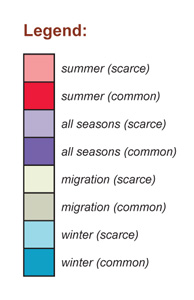
North American Range Map
Family Members
 Fulvous Whistling-DuckDendrocygna bicolor
 Taiga Bean-GooseAnser fabalis
 Greater White-fronted GooseAnser albifrons
 Emperor GooseChen canagica
 Snow GooseChen caerulescens
 Ross's GooseChen rossii
 BrantBranta bernicla
 Cackling GooseBranta hutchinsii
 Canada GooseBranta canadensis
 Mute SwanCygnus olor
 Trumpeter SwanCygnus buccinator
 Tundra SwanCygnus columbianus
 Wood DuckAix sponsa
 GadwallAnas strepera
 Falcated DuckAnas falcata
 Eurasian WigeonAnas penelope
 American WigeonAnas americana
 American Black DuckAnas rubripes
 MallardAnas platyrhynchos
 Blue-winged TealAnas discors
 Cinnamon TealAnas cyanoptera
 Northern ShovelerAnas clypeata
 Northern PintailAnas acuta
 GarganeyAnas querquedula
 Baikal TealAnas formosa
 Green-winged TealAnas crecca
 CanvasbackAythya valisineria
 RedheadAythya americana
 Ring-necked DuckAythya collaris
 Tufted DuckAythya fuligula
 Greater ScaupAythya marila
 Lesser ScaupAythya affinis
 Steller's EiderPolysticta stelleri
 King EiderSomateria spectabilis
 Common EiderSomateria mollissima
 Harlequin DuckHistrionicus histrionicus
 Surf ScoterMelanitta perspicillata
 White-winged ScoterMelanitta fusca
 Black ScoterMelanitta nigra
 Long-tailed DuckClangula hyemalis
 BuffleheadBucephala albeola
 Common GoldeneyeBucephala clangula
 Barrow's GoldeneyeBucephala islandica
 SmewMergellus albellus
 Hooded MerganserLophodytes cucullatus
 Common MerganserMergus merganser
 Red-breasted MerganserMergus serrator
 Ruddy DuckOxyura jamaicensis