


Fox Sparrow
General Description
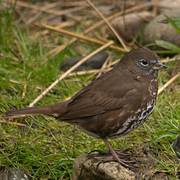
The Fox Sparrow is a large, chunky sparrow that is highly variable in appearance, depending on geographical region. It is dark and unstreaked on its back, varying from gray-brown, to dark brown, to rufous. The tail is typically redder than the back. The breast is heavily spotted, and the spots are shaped like chevrons that converge in a central spot on the breast. The head is not striped or streaked, the face is plain, and the lower mandible is yellow. The combination of the chevron markings, red tail, plain face, and yellow mandible are good field marks to use to identify the Fox Sparrow.
Habitat
Breeding Fox Sparrows can be found at high elevations, especially in wet meadows or in scattered conifers. Wintering Fox Sparrows inhabit recent clearcuts and tangled brush, especially blackberry thickets.
Behavior
Fox Sparrows are not typically found in flocks. Ground-foragers, they scratch in the leaf litter with a two-footed jump-kick motion.
Diet
Seeds, especially from grasses and smartweeds (Polygonum spp.), are typical diet items throughout the year. In the spring and summer, Fox Sparrows eat insects and feed them to their young. Berries, when available, are also a staple. Birds in coastal areas will eat tiny crustaceans and other small marine creatures found on the beach.
Nesting
The male sings to defend his nesting territory and attract a mate. The female builds the nest, a bulky cup made of grass, moss, and twigs, lined with hair, fine grass, moss, and feathers. The nest is located on the ground, in a shrub, or in a tree. Ground nests are usually on a grassy hummock, hidden under dense shrub cover. Nests in shrubs or trees are attached to branches and are usually bulkier, with more twigs than their counterparts on the ground. The female incubates 3 to 4 eggs for 12 to 14 days. Both parents help feed the young, which leave the nest at 9 to 11 days. Pairs generally raise two broods per year.
Migration Status
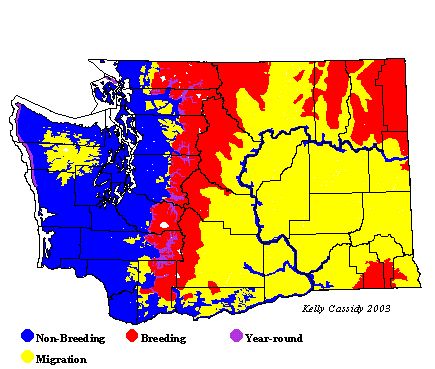
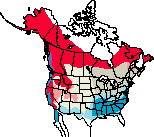
The migration status of the Fox Sparrow is confounded by overlaps between the various groups. Generally, Fox Sparrows winter in the southern United States, but some groups may winter as far north as coastal Washington. Many of the Fox Sparrows that breed in Washington winter to the south. Some winter in Washington or travel short distances down the coast. Northern coastal breeders from British Columbia and Alaska move into western Washington for the winter. Migration tends to be early in spring and late in fall.
Conservation Status
The two breeding subspecies breed in non-overlapping areas.
When and Where to Find in Washington
There are 19 recognized races of Fox Sparrows. These are divided into four groups that may be split into separate species at some point. Fox Sparrows breeding in Washington belong to two groups, and wintering and migrating birds come from a third. The Sooty Fox Sparrow is an uncommon and local breeder in shrubby habitats along the outer coast, around Cape Flattery, on Tatoosh Island, and on some of the San Juan Islands north of Orcas Island. These birds migrate down the coast and into western Washington. Other Sooty Fox Sparrows migrate into Washington from points north. They can be seen in eastern Washington during migration, and are abundant winter residents in western Washington and north into British Columbia. One race of the Slate-colored Fox Sparrow breeds at higher elevations in the eastern Cascades and northeastern Washington, and another race breeds in the Blue Mountains. They are locally common in these areas during the breeding season, but leave Washington during the winter. The Red Fox Sparrow, the northernmost subspecies, has been recorded passing through Washington but only rarely.
 Abundance
| Ecoregion | Jan | Feb | Mar | Apr | May | Jun | Jul | Aug | Sep | Oct | Nov | Dec |
|---|---|---|---|---|---|---|---|---|---|---|---|---|
| Oceanic | ||||||||||||
| Pacific Northwest Coast | C | C | C | C | F | U | U | U | U | C | C | C |
| Puget Trough | C | C | C | C | F | R | R | R | F | C | C | C |
| North Cascades | U | U | U | U | F | F | F | U | U | U | U | U |
| West Cascades | C | C | C | F | F | F | F | F | F | C | C | C |
| East Cascades | R | R | R | U | F | F | F | U | U | U | R | R |
| Okanogan | U | F | F | U | U | F | F | U | U | |||
| Canadian Rockies | U | F | F | F | F | F | U | |||||
| Blue Mountains | R | F | F | F | F | U | R | |||||
| Columbia Plateau | U | U | U | U | U | U | U | U | U |
Washington Range Map
North American Range Map
Family Members
 Green-tailed TowheePipilo chlorurus
 Spotted TowheePipilo maculatus
 American Tree SparrowSpizella arborea
 Chipping SparrowSpizella passerina
 Clay-colored SparrowSpizella pallida
 Brewer's SparrowSpizella breweri
 Vesper SparrowPooecetes gramineus
 Lark SparrowChondestes grammacus
 Black-throated SparrowAmphispiza bilineata
 Sage SparrowAmphispiza belli
 Lark BuntingCalamospiza melanocorys
 Savannah SparrowPasserculus sandwichensis
 Grasshopper SparrowAmmodramus savannarum
 Le Conte's SparrowAmmodramus leconteii
 Nelson's Sharp-tailed SparrowAmmodramus nelsoni
 Fox SparrowPasserella iliaca
 Song SparrowMelospiza melodia
 Lincoln's SparrowMelospiza lincolnii
 Swamp SparrowMelospiza georgiana
 White-throated SparrowZonotrichia albicollis
 Harris's SparrowZonotrichia querula
 White-crowned SparrowZonotrichia leucophrys
 Golden-crowned SparrowZonotrichia atricapilla
 Dark-eyed JuncoJunco hyemalis
 Lapland LongspurCalcarius lapponicus
 Chestnut-collared LongspurCalcarius ornatus
 Rustic BuntingEmberiza rustica
 Snow BuntingPlectrophenax nivalis
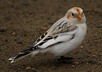 McKay's BuntingPlectrophenax hyperboreus