
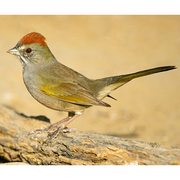

Green-tailed Towhee

General Description
The Green-tailed Towhee is gray underneath with greenish upperparts. Adults have a rufous crown and a white throat-patch. Juvenile birds are brown-and-white streaked, with a yellowish wash on their wings.
Habitat
A bird of the dry, shrubby hillsides of far-southeastern Washington, the Green-tailed Towhee breeds in areas with a high diversity of shrub species providing dense, low cover. During migration and winter, it is found in similar habitats, often near streams.
Behavior
In winter, Green-tailed Towhees can be found in mixed flocks. These secretive birds forage on the ground and in low bushes, scratching leaf litter with both feet.
Diet
Small insects and seeds make up the majority of the Green-tailed Towhee's diet. They also eat some fruit.
Nesting
The male defends a territory and attracts a mate by singing from a prominent spot, often a raised perch. Females arrive on the breeding grounds about a week after the males, and monogamous pairs form shortly after that. The female builds a bulky but well-concealed nest on the ground or in a low shrub, within three feet of the ground. The nest is made of twigs, grass, weeds, and bark, and lined with grass, rootlets, and hair. The female lays 3 to 4 eggs and incubates them for about 12 days. Both parents feed the chicks. The young leave the nest at 11 to 14 days of age, but are not yet able to fly. The parents continue to feed and tend the young until they can fly and fend for themselves.
Migration Status
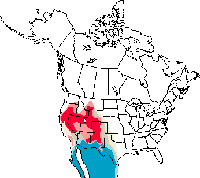
The Green-tailed Towhee is the only entirely migratory towhee. Staying only briefly in Washington, these birds arrive on the breeding grounds in June and leave for Mexico and the southwestern US in August.
Conservation Status
Breeding Bird Survey records indicate that there have been no major changes in the Washington population since 1966. Humans have had both positive and negative effects on Green-tailed Towhee populations. Fire suppression may reduce habitat, but logging may provide more habitat. The replacement of sagebrush with non-native grasses has probably had a significant negative impact on Green-tailed Towhee habitat overall. The Washington population is very small and limited in area. This population is at the northern edge of the range and because of this is not likely to ever be widespread or common in Washington.
When and Where to Find in Washington
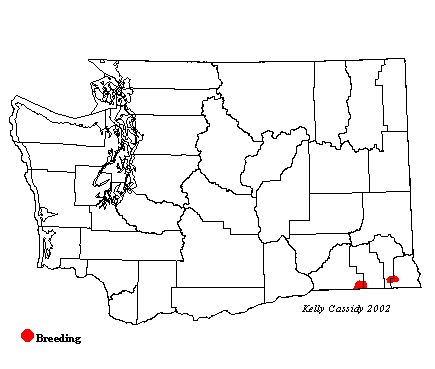
Green-tailed Towhees are local and uncommon breeders at moderate elevations in steep, shrubby areas of the Blue Mountains in far-southeastern Washington. They breed at the Wenatchee Guard Station, the Asotin Creek Wildlife Area in Asotin County, and along the south slopes of the Blue Mountains, at Biscuit Ridge, near Dixie in Walla Walla County.
 Abundance
| Ecoregion | Jan | Feb | Mar | Apr | May | Jun | Jul | Aug | Sep | Oct | Nov | Dec |
|---|---|---|---|---|---|---|---|---|---|---|---|---|
| Oceanic | ||||||||||||
| Pacific Northwest Coast | ||||||||||||
| Puget Trough | ||||||||||||
| North Cascades | ||||||||||||
| West Cascades | ||||||||||||
| East Cascades | ||||||||||||
| Okanogan | ||||||||||||
| Canadian Rockies | ||||||||||||
| Blue Mountains | R | R | R | R | ||||||||
| Columbia Plateau |
Washington Range Map
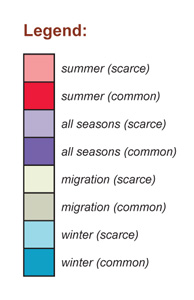
North American Range Map
Family Members
 Green-tailed TowheePipilo chlorurus
 Spotted TowheePipilo maculatus
 American Tree SparrowSpizella arborea
 Chipping SparrowSpizella passerina
 Clay-colored SparrowSpizella pallida
 Brewer's SparrowSpizella breweri
 Vesper SparrowPooecetes gramineus
 Lark SparrowChondestes grammacus
 Black-throated SparrowAmphispiza bilineata
 Sage SparrowAmphispiza belli
 Lark BuntingCalamospiza melanocorys
 Savannah SparrowPasserculus sandwichensis
 Grasshopper SparrowAmmodramus savannarum
 Le Conte's SparrowAmmodramus leconteii
 Nelson's Sharp-tailed SparrowAmmodramus nelsoni
 Fox SparrowPasserella iliaca
 Song SparrowMelospiza melodia
 Lincoln's SparrowMelospiza lincolnii
 Swamp SparrowMelospiza georgiana
 White-throated SparrowZonotrichia albicollis
 Harris's SparrowZonotrichia querula
 White-crowned SparrowZonotrichia leucophrys
 Golden-crowned SparrowZonotrichia atricapilla
 Dark-eyed JuncoJunco hyemalis
 Lapland LongspurCalcarius lapponicus
 Chestnut-collared LongspurCalcarius ornatus
 Rustic BuntingEmberiza rustica
 Snow BuntingPlectrophenax nivalis
 McKay's BuntingPlectrophenax hyperboreus