
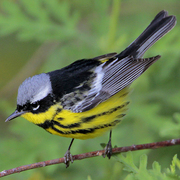


Magnolia Warbler
General Description
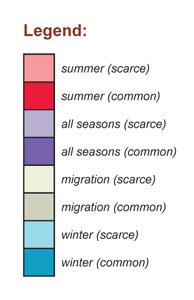
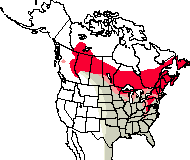
The Magnolia Warbler breeds in moist coniferous and mixed forest from Yukon and British Columbia to Newfoundland and the Maritimes, mostly in Canada but also in the upper Midwest, New England, and the Appalachians. It migrates east of the Great Plains, crossing the Gulf of Mexico to and from its wintering grounds in southeastern Mexico and Central America, but is also one of the more common vagrant “eastern” warblers seen in the western United States. Oregon and Idaho both have more than 20 records. Washington has 12 accepted records, seven east of the Cascades and five from westside coastal lowlands. Nine are from fall (September–October), while two occurred in late May at Ione (Pend Oreille County) and near Dixie (Walla Walla County). The other record was of a male singing on territory near Twisp (Okanogan County) for nearly a month, 8 June–4 July 1996.
In fall, when it is most likely to be seen in Washington, this species has greenish upperparts, a gray head with a prominent white eye-ring, two white wingbars, yellow underparts from chin to belly, streaked sides (sometimes weakly), and white undertail coverts. Key field marks are the yellow rump, white underside of the front half of the tail, and wide white band visible on the spread tail. There is considerable variation in plumage by age, sex, and season. In particular, breeding birds are much more strongly patterned: consult a good field guide for details.
Revised October 2007
North American Range Map
Family Members
 Blue-winged WarblerVermivora pinus
 Golden-winged WarblerVermivora chrysoptera
 Tennessee WarblerVermivora peregrina
 Orange-crowned WarblerVermivora celata
 Nashville WarblerVermivora ruficapilla
 Northern ParulaParula americana
 Yellow WarblerDendroica petechia
 Chestnut-sided WarblerDendroica pensylvanica
 Magnolia WarblerDendroica magnolia
 Cape May WarblerDendroica tigrina
 Black-throated Blue WarblerDendroica caerulescens
 Yellow-rumped WarblerDendroica coronata
 Black-throated Gray WarblerDendroica nigrescens
 Black-throated Green WarblerDendroica virens
 Townsend's WarblerDendroica townsendi
 Hermit WarblerDendroica occidentalis
 Blackburnian WarblerDendroica fusca
 Yellow-throated WarblerDendroica dominica
 Prairie WarblerDendroica discolor
 Palm WarblerDendroica palmarum
 Bay-breasted WarblerDendroica castanea
 Blackpoll WarblerDendroica striata
 Black-and-white WarblerMniotilta varia
 American RedstartSetophaga ruticilla
 Prothonotary WarblerProtonotaria citrea
 OvenbirdSeiurus aurocapilla
 Northern WaterthrushSeiurus noveboracensis
 Kentucky WarblerOporornis formosus
 Mourning WarblerOporornis philadelphia
 MacGillivray's WarblerOporornis tolmiei
 Common YellowthroatGeothlypis trichas
 Hooded WarblerWilsonia citrina
 Wilson's WarblerWilsonia pusilla
 Yellow-breasted ChatIcteria virens