
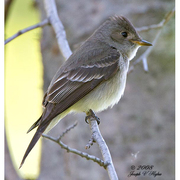

Western Wood-Pewee
General Description
The Western Wood-Pewee is a small, nondescript, gray bird with two lighter wing-bars and no eye-ring. It has a whitish throat, dark bill, and slight crest.
Habitat
Western Wood-Pewees use a variety of habitats, including open coniferous forests, wooded streams, and forest edges.
Behavior
These active foragers concentrate in the sub-canopy layer, flying out from an exposed perch to grab prey in mid-air, and then returning to the perch. They also hover beside foliage, gleaning prey from the surface of leaves and twigs.
Diet
Flying insects are the predominant prey.
Nesting
The male sings to defend a nesting territory and attract a mate. The female builds the nest on a horizontal branch, usually well out from the trunk. The nest is a compact cup of grass, plant fiber, feathers, and hair in a spider-web frame, at varying heights from the ground. The outside of the nest is camouflaged with moss, bud scales, leaves, and lichen, and often looks like a bump or knot on the branch. Typically, clutches are three eggs, but can be from two to four eggs. The female incubates the eggs for 14 to 15 days. Both parents help feed the young, which fledge at about 16 days, and leave the nest area within three days of fledging.
Migration Status
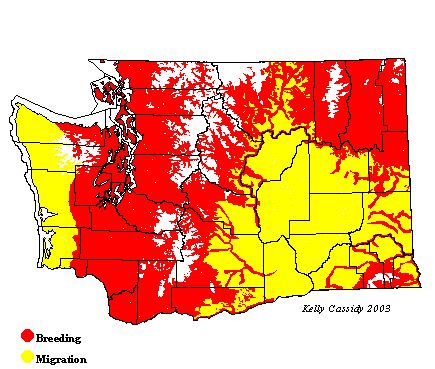
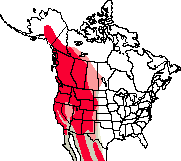
Western Wood-Pewees spend the winter in northern and western South America and are late returnees to the Northwest. They generally arrive in mid-May and depart in late August and September.
Conservation Status
Two subspecies of Western Wood-Pewee are found in Washington, divided by the Cascade Mountains. While in general this species is widespread and abundant, populations are declining in many areas. Declines have been attributed to loss and degradation of habitat on both the breeding grounds and the wintering grounds. Creation of clearings attracts this species, which shuns dense forests. Thus it may inhabit edges of clear-cuts for 5 to 10 years, then vanish as new growth develops. Forest fragmentation creates additional edge habitat and may result in increased populations. Cattle grazing appears to degrade habitat.
When and Where to Find in Washington
Western Wood-Pewees are most common in eastern Washington at lower elevations, within the forested zone. They can be found in western Washington, especially in some of the dry areas in the San Juan Islands (especially Lopez Island) and on the northeastern Olympic Peninsula. Look for them in clear-cuts. They are also common along the coast, at Grays Harbor and Willapa Bay.
 Abundance
| Ecoregion | Jan | Feb | Mar | Apr | May | Jun | Jul | Aug | Sep | Oct | Nov | Dec |
|---|---|---|---|---|---|---|---|---|---|---|---|---|
| Oceanic | ||||||||||||
| Pacific Northwest Coast | U | U | U | U | U | |||||||
| Puget Trough | U | F | F | F | U | |||||||
| North Cascades | F | F | F | F | R | |||||||
| West Cascades | F | C | C | F | R | |||||||
| East Cascades | C | C | C | C | F | |||||||
| Okanogan | C | C | C | C | U | |||||||
| Canadian Rockies | F | F | F | F | ||||||||
| Blue Mountains | F | C | C | C | C | |||||||
| Columbia Plateau | C | C | C | C | C |
Washington Range Map
North American Range Map
Family Members
 Olive-sided FlycatcherContopus cooperi
 Western Wood-PeweeContopus sordidulus
 Alder FlycatcherEmpidonax alnorum
 Willow FlycatcherEmpidonax traillii
 Least FlycatcherEmpidonax minimus
 Hammond's FlycatcherEmpidonax hammondii
 Gray FlycatcherEmpidonax wrightii
 Dusky FlycatcherEmpidonax oberholseri
 Western FlycatcherEmpidonax difficilis
 Black PhoebeSayornis nigricans
 Eastern PhoebeSayornis phoebe
 Say's PhoebeSayornis saya
 Vermilion FlycatcherPyrocephalus rubinus
 Ash-throated FlycatcherMyiarchus cinerascens
 Tropical KingbirdTyrannus melancholicus
 Western KingbirdTyrannus verticalis
 Eastern KingbirdTyrannus tyrannus
 Scissor-tailed FlycatcherTyrannus forficatus
 Fork-tailed FlycatcherTyrannus savana