
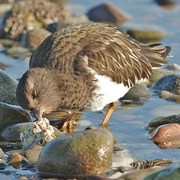


Black Turnstone

General Description
The Black Turnstone is a compact, short-billed bird found on rocky shores. All plumages are mostly black with white bellies. Their bellies and underwings are white, and their heads and breasts are black. In flight, they show white on the back, wings, and base of the tail. In breeding plumage, the Black Turnstone has a white mustache and some white on the breast. Its legs are orange-brown and can be quite bright, although not as bright as those of the Ruddy Turnstone. Males and females appear similar, but males are brighter with more contrast in color on the head. Their long, black wing coverts contrast with their white sides.
Habitat
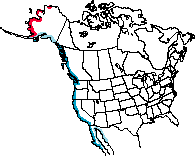
A coastal species at all times of the year, Black Turnstones nest in the wet tundra of coastal Alaska, often near estuaries or lagoons. They migrate and winter along the rocky shorelines of the Pacific Coast. They are most often found foraging on rocky shores, jetties, and islets. They also forage on top of kelp beds.
Behavior
Black Turnstones are usually found in small flocks, but they may number 100 or more.
The Black Turnstone moves steadily and slowly over rocks, looking for prey to pry off with its strong bill, thus its name. On beaches it turns over rocks and shells in search of food, although not as often as the related Ruddy Turnstone.
Diet
Limpets and acorn barnacles are the most important food items on the wintering grounds of the Black Turnstone. During the breeding season, they eat many insects as well as some berries and seeds.
Nesting
Black Turnstones return to the same nest and pair with the same mate year after year. They nest on the ground, among sedges or grasses close to water. The nest is sometimes out in the open, sometimes hidden by tall vegetation. Both parents help make the shallow scrape lined with grass. Both help incubate the four eggs for 22-24 days. The young leave the nest shortly after hatching and find their own food. Both parents tend the young, but the female leaves about two weeks post-hatching, and the male cares for the young until they are independent. They begin to make short flights at 23 days, and have mastered sustained flight by 28-30 days.
Migration Status
Migrants follow the coastline closely in spring on their way back to coastal breeding grounds in Alaska. In the fall, some birds cut across the Gulf of Alaska to shorten their trip south. They winter from the southern coast of Alaska down the Pacific to Mexico.
Conservation Status
The Canadian Wildlife Service estimates the population at 80,000 birds. Christmas Bird Count data suggest that there has been a decline in recent years. Black Turnstones are listed as a species of special concern on the Partners in Flight watch list.
When and Where to Find in Washington
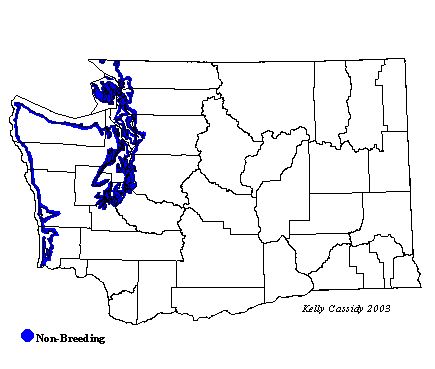
Black Turnstones are common throughout the winter on rocky shores along the outer coast of Washington and in Puget Sound south to Seattle. They start leaving for the breeding grounds in mid-May and are rare in Washington by the first half of June. A few birds return in late June, more arrive in July, and they are once again common by mid-July. Juveniles follow in August. There are a few scattered records inland, but the Black Turnstone is primarily a bird of the coast. Penn Cove on Whidbey Island (Island County) is an excellent place to see them, as are Alki Beach in West Seattle (King County) and Drayton Harbor (Whatcom County).
 Abundance
| Ecoregion | Jan | Feb | Mar | Apr | May | Jun | Jul | Aug | Sep | Oct | Nov | Dec |
|---|---|---|---|---|---|---|---|---|---|---|---|---|
| Oceanic | ||||||||||||
| Pacific Northwest Coast | C | C | C | C | U | U | C | C | C | C | C | |
| Puget Trough | C | C | C | C | U | U | U | F | C | C | C | |
| North Cascades | ||||||||||||
| West Cascades | ||||||||||||
| East Cascades | ||||||||||||
| Okanogan | ||||||||||||
| Canadian Rockies | ||||||||||||
| Blue Mountains | ||||||||||||
| Columbia Plateau |
Washington Range Map
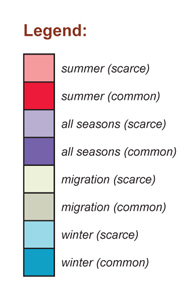
North American Range Map
Family Members
 Spotted SandpiperActitis macularius
 Solitary SandpiperTringa solitaria
 Gray-tailed TattlerTringa brevipes
 Wandering TattlerTringa incana
 Greater YellowlegsTringa melanoleuca
 WilletTringa semipalmata
 Lesser YellowlegsTringa flavipes
 Upland SandpiperBartramia longicauda
 Little CurlewNumenius minutus
 WhimbrelNumenius phaeopus
 Bristle-thighed CurlewNumenius tahitiensis
 Long-billed CurlewNumenius americanus
 Hudsonian GodwitLimosa haemastica
 Bar-tailed GodwitLimosa lapponica
 Marbled GodwitLimosa fedoa
 Ruddy TurnstoneArenaria interpres
 Black TurnstoneArenaria melanocephala
 SurfbirdAphriza virgata
 Great KnotCalidris tenuirostris
 Red KnotCalidris canutus
 SanderlingCalidris alba
 Semipalmated SandpiperCalidris pusilla
 Western SandpiperCalidris mauri
 Red-necked StintCalidris ruficollis
 Little StintCalidris minuta
 Temminck's StintCalidris temminckii
 Least SandpiperCalidris minutilla
 White-rumped SandpiperCalidris fuscicollis
 Baird's SandpiperCalidris bairdii
 Pectoral SandpiperCalidris melanotos
 Sharp-tailed SandpiperCalidris acuminata
 Rock SandpiperCalidris ptilocnemis
 DunlinCalidris alpina
 Curlew SandpiperCalidris ferruginea
 Stilt SandpiperCalidris himantopus
 Buff-breasted SandpiperTryngites subruficollis
 RuffPhilomachus pugnax
 Short-billed DowitcherLimnodromus griseus
 Long-billed DowitcherLimnodromus scolopaceus
 Jack SnipeLymnocryptes minimus
 Wilson's SnipeGallinago delicata
 Wilson's PhalaropePhalaropus tricolor
 Red-necked PhalaropePhalaropus lobatus
 Red PhalaropePhalaropus fulicarius